
Google Ads for Home Service Businesses
A homeowner types "water heater replacement near me." That search is worth hundreds of dollars, and Google auctions it in real time. Google Ads is how you win those moments, and how badly it's managed determines whether it's your best channel or an expensive leak.
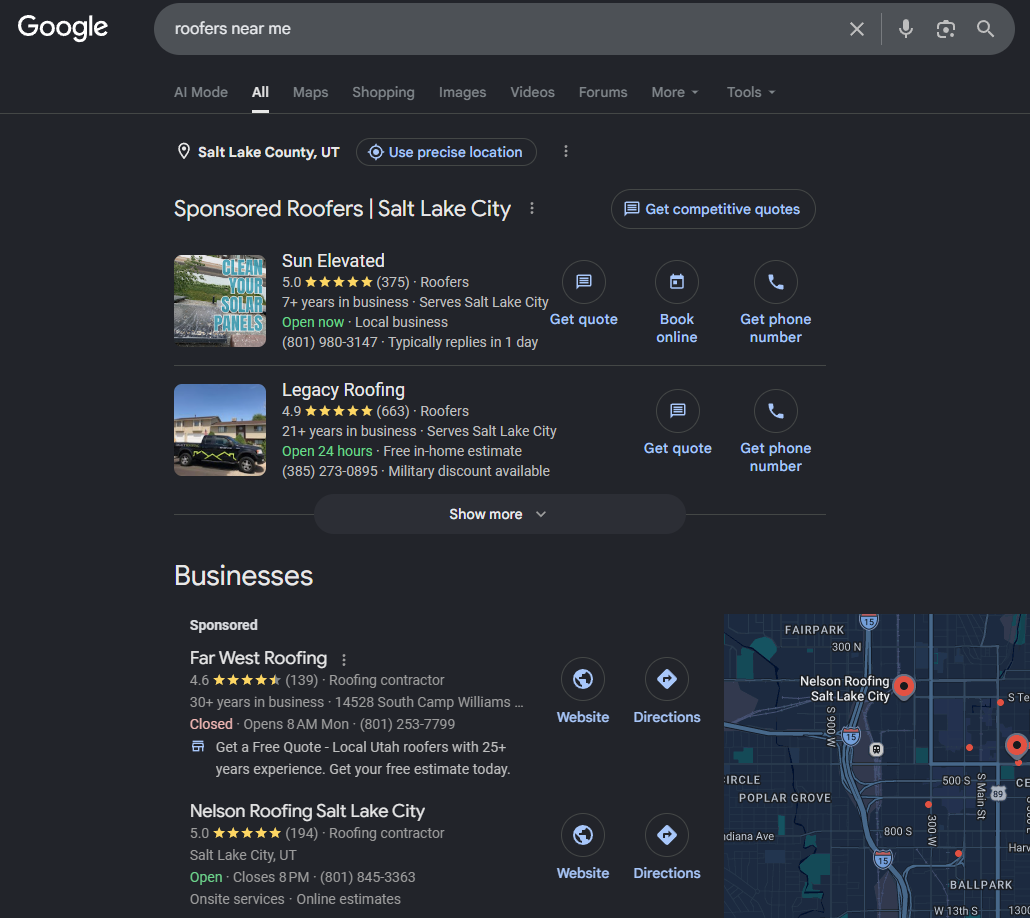
Why Google Ads Works for Home Services (and Where It Goes Wrong)
The intent is the whole story. Nobody searches "emergency plumber" casually. Search ads intercept buyers at the exact moment of need, which no other channel does.
For example, one Utah County roofing company we work with watched their digital pipeline consistently outproduce their door-to-door sales team, and cut the D2D operation entirely.
Where it goes wrong: broad match keywords burning budget on garbage searches, no negative keyword discipline, ads pointing at a homepage instead of a converting page, and no call tracking, so nobody actually knows what a lead costs. That's the state of most home service ad accounts we look at. The waste isn't in the platform, it's in the management.
The Numbers Worth Knowing
Industry averages put home services cost per lead on Google Ads roughly between $80 and $300 depending on niche, market, and season. High-ticket trades run the top of that range, and a single booked job typically covers many multiples of its lead cost. The number that matters is yours, tracked weekly, not the industry's.
What we do
Campaign architecture. Structured by service and intent, so a furnace-repair search sees a furnace-repair ad pointing at a furnace-repair page. Obvious, and rarely done.
Keyword and negative keyword management. Continuous search-term review, cutting spend on searches that will never become jobs.
Ad copy built for your market. Written to your services, offers, and differentiators. Tested and iterated against real performance data.
Landing page alignment. Ads are half the job. Where the click lands decides whether it converts, and page fixes are in scope, not an upsell.
Full tracking. Call tracking, form tracking, and attribution installed before spend scales. Reporting shows cost per lead and, once you flag booked jobs, cost per job by campaign.
Budget stewardship. Your budget scales when the data earns it, not because a rep wants a bigger account.
Frequently Asked Questions
-
Enough to generate statistically meaningful data in your market, which for most trades means a starting budget that can buy at least a few hundred clicks a month. The honest answer depends on your niche's click costs and your capacity to handle leads. We size budgets to your market, not to a template.
-
Usually within the first one to two weeks of launch. The first 60 to 90 days are a tuning window where cost per lead improves as search-term data accumulates. Anyone promising perfectly efficient spend in week one hasn't run many accounts.
-
Industry averages run roughly $80 to $300 depending on the trade and market. But the benchmark that matters is your cost per booked job against your average ticket. A $250 lead is cheap when it books a $12,000 roof and expensive when it books a $150 service call.
-
Our packages run month to month. Ads perform on data, and data takes a couple of months to mature, so we'll tell you upfront that 90 days is the honest evaluation window. But we keep clients with results, not contracts.
-
Both, when you're eligible for LSA. They occupy different real estate on the results page, and together they cover more of it. LSA bills per lead with less control; Google Ads costs more per lead with far more targeting and messaging control. The mix depends on your niche and market.